
Cable Management
& Remediation
in Sacramento
We clean up, re-dress, label, and document server rooms, IDF closets, and structured cabling infrastructure that has accumulated years of undocumented changes across Sacramento commercial buildings. Before-and-after photo documentation. Updated port maps. Certified test records. Your telecom room — made manageable again.
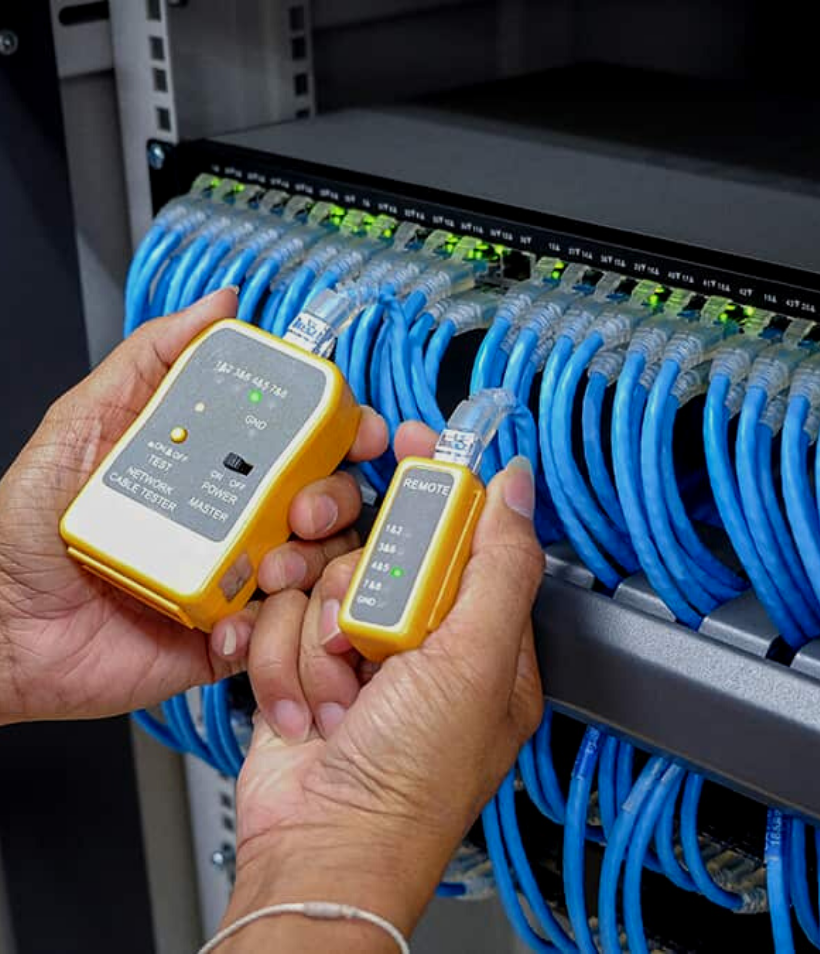
A structured cabling installation that was clean and documented on day one degrades over years of moves, adds, and changes — especially in businesses that grow, reorganise, or have had multiple IT staff or contractors making changes without maintaining records. Each unlabelled patch cord added in a hurry, each dead cable left in place “just in case,” each port map that was never updated — they accumulate. After five or ten years, many Sacramento server rooms and IDF closets are genuinely unmanageable.
This isn’t a cosmetic problem. An IT team that can’t identify which patch cord connects to which desk spends hours on moves and changes that should take minutes. A bundle of decommissioned cable filling a ceiling plenum is a fire load that violates NEC code. An unlabelled patch panel makes troubleshooting a network outage a guessing game. A telecom room with no documentation is infrastructure nobody can manage confidently — and infrastructure that any competent external contractor charges extra to work in because they have to figure out what exists before they can do anything.
We remediate cabling infrastructure across Sacramento — from single IDF closets that need a day of cleanup and labelling to multi-floor commercial buildings requiring complete re-documentation, dead cable removal, and physical re-dressing. The result isn’t just a tidy room — it’s infrastructure your IT team can actually manage, with documentation that survives staff turnover.
Active Port Verification
Before removing anything, we identify every active port and every decommissioned port. A tone generator and probe traces unlabelled patch cords to their source. Network ports are tested for link activity. PoE ports are verified against connected devices. Only confirmed-dead connections are removed.
Patch Cord Re-Organisation
Decommissioned patch cords removed. Active cords replaced with the correct length — a 1-foot patch cord between adjacent panels, a 3-foot cord between panels one space apart. Patch cords dressed through horizontal cable managers, velcro-wrapped in bundles, with consistent routing and no cross-over tangles.
Cable Manager Installation
Horizontal and vertical cable managers installed where missing — between patch panels, between panels and switches, and at rack top and bottom. Cable management hardware is what makes a clean installation stay clean. Without it, the next technician who makes a change puts it back the way it was.
Rack Re-Organisation
Equipment repositioned in the rack to logical groupings — patch panels above switches they serve, consistent spacing between equipment tiers, 1U blanking panels filling unused slots to maintain airflow. Power cords dressed rear-of-rack separately from data cables.
Fibre Cable Management
Fibre patch cords re-routed with correct bend radius (no tight corners, no zip ties), managed in dedicated fibre channels separate from copper patch cords. MPO trunks properly supported through overhead fibre trays. End-face inspection and cleaning for any fibre connectors that are re-mated during the project.
Before & After Photo Documentation
A complete photo set of every rack, every patch panel face, and the room from multiple angles — taken before work begins and again after completion. Delivered with the project documentation so you have a permanent record of the before state and the completed state.
IDF Cleanup Deliverables
Working in Occupied Sacramento Buildings Without Disruption
Most IDF cleanup projects in Sacramento take place in occupied commercial buildings where any disruption to the network means disruption to the business. We plan the work so active connections are never touched while the port is in use — we work around the live ports, remove and re-dress decommissioned and inactive connections, then schedule brief maintenance windows for any active port that needs to be moved or re-terminated. For organisations where even a brief maintenance window is difficult, we schedule the active work in early morning hours before the business day begins. We’ve done IDF cleanups in occupied DTLA law firms, Century City financial offices, and Burbank production facilities without a single unplanned outage.
Physical Cable Tracing
Every unlabelled or inconsistently labelled cable physically traced from end to end using a tone generator and inductive probe. Each run gets a unique cable ID recorded during tracing. This is the foundation of any labelling project — you can’t label accurately without knowing what each cable connects to.
Consistent Labelling Convention
A labelling convention designed for your infrastructure — typically room/rack/panel/port at the IDF end, and floor/zone/outlet at the desk end. Labels printed on a Brady BMP61 label printer with heat-shrink or adhesive labels rated for the cable type. The same convention applied consistently across every IDF, every patch panel, every outlet.
Both-Ends Labelling
Every cable labelled at both ends — patch panel port label and outlet faceplate label with the same cable ID. When a technician reads a label at the outlet, they know exactly which patch panel port to look at. When they read the patch panel label, they know exactly which outlet it serves. No tracing required for any labelled cable.
Port Map Creation
A complete port map spreadsheet built from the physical tracing — patch panel port → cable ID → outlet location → device type (data, voice, AP, camera, etc.) → current device name if provided by IT. Delivered as an Excel or Google Sheets file, formatted for easy lookup and ongoing maintenance by your IT team.
As-Built Floor Plan
A floor plan showing every outlet location, labelled with its cable ID, and the IDF serving that zone. Created from your existing floor plan or sketched from site measurements if no floor plan is available. The document your next contractor needs to do any work in your building without having to re-trace everything.
Documentation Update
For buildings with existing documentation that’s become inaccurate through years of undocumented changes — we reconcile the existing port map against the physical plant, identify discrepancies, update the documentation to match what’s actually installed, and deliver the corrected document set.
Labelling & Documentation Deliverables
Why Sacramento Businesses Prioritise Documentation After IT Staff Changes
We receive a significant number of cable labelling and documentation calls from Sacramento businesses that have recently experienced IT staff turnover — particularly when a long-tenured IT manager or systems administrator leaves and takes institutional knowledge with them. In these situations, the business often discovers for the first time that the infrastructure exists entirely in one person’s head, with no written documentation. We treat these projects with urgency — getting a complete, accurate port map and labelling system in place before the next network incident makes the lack of documentation a crisis. We’ve done these emergency documentation projects for law firms, financial services offices, and healthcare organisations throughout Sacramento County.
Server room or IDF closet out of control in your Sacramento building?
We assess, quote, and remediate — without disrupting your live network. Free site assessment across Sacramento County.
Active vs Dead Identification
Before any cable is touched, we identify every active and decommissioned run in the scope. Tone generator tracing, link activity testing, and physical termination checks at both ends. A cable is confirmed dead before it’s pulled — not assumed dead because it looks unused. We’ve seen too many Sacramento buildings where “unused” cables were actually active circuits for security systems, fire alarm monitoring, or analog phone lines.
Ceiling Plenum Cable Removal
Pulling decommissioned cable from ceiling plenum spaces in occupied Sacramento commercial buildings — most commonly Cat5e installed in the 1990s and 2000s, now replaced by Cat6A infrastructure. Clean ceiling access via existing ceiling grid, careful routing to avoid disturbing HVAC, sprinkler, and active cabling pathways. NEC 800.25-compliant removal and disposal.
In-Wall Cable Removal
Pulling decommissioned cable from wall cavities in drywall and masonry construction — common in older Sacramento commercial buildings that have been repeatedly re-cabled. In-wall removal requires more care than plenum work: access is limited, cables often share space with electrical and other building systems, and pulling without proper technique risks damaging finish surfaces.
Conduit Clearing
Removing decommissioned cable from conduit runs — leaving the conduit clear and available for future use. We pull old cable out, clear any cable jam or blockage, and leave the conduit accessible with a pull string for the next installation. Common in older Sacramento concrete commercial buildings where conduit was installed for the original phone and data infrastructure.
IDF Cord & Panel Removal
Removing decommissioned patch panels, active equipment trays, and unused patch cords from IDF closets — creating space for new infrastructure or simply reducing the clutter that makes the room unmanageable. Equipment removed is set aside for IT disposition or recycled appropriately.
Disposal & Recycling
Removed cable is bundled and weighed for documentation. Copper cabling can be recycled — we coordinate disposal with appropriate recycling facilities. We provide a disposal record showing cable type, approximate quantity by weight, and disposal method — useful for building management documentation and environmental compliance records.
Dead Cable Removal Deliverables
NEC 800.25 — Abandoned Cable in Sacramento Commercial Buildings
Section 800.25 of the National Electrical Code requires that “abandoned communications cables” be removed. A cable is considered abandoned when it is not terminated at equipment in use and not tagged for future use. The 2020 California Electrical Code (which most Sacramento jurisdictions have adopted) includes this provision. In practice, building management companies in DTLA, Century City, and Playa Vista are increasingly including abandoned cable removal requirements in tenant improvement scopes and lease renewals. Building inspections for fire code compliance also cite accumulated cable in plenum spaces. We include NEC 800.25 compliance documentation with every dead cable removal project so you have the records if building management or a fire inspector asks.
Keystone & Patch Panel Re-Termination
The most common remediation task in Sacramento commercial buildings. Keystones and patch panel jacks re-terminated with correct pair untwist (≤13mm Cat5e, ≤6mm Cat6), proper pair seating in IDC contacts, and strain relief correctly installed. Every re-terminated port re-tested to TIA-568.2-D Level IV after remediation.
Damaged Cable Run Replacement
Replacement of cable runs that have been physically damaged — kinked, crushed, cut, or damaged by improper installation. We pull the replacement cable through the existing pathway, terminate at both ends, label to the existing convention, and certify. The new run is indistinguishable from a fresh installation in the documentation.
Pathway Remediation
Correcting cable pathway issues that violate TIA-569-D standards: cables crushed under ceiling tiles, cables with bend radii tighter than the minimum, overfilled conduit runs, cables bearing their own weight unsupported over long spans. Pathway remediation often involves installing additional cable support, rerouting through correct pathways, and replacing bent or kinked sections.
Cat5e to Cat6A Upgrades
Targeted replacement of Cat5e runs that cannot support 10G or PoE++ requirements — common in Sacramento offices planning 10G switch deployments or WiFi 6E installations where existing Cat5e can’t support the PoE power budget or distance requirements. We replace the specified runs, match the labelling convention, and certify the new infrastructure.
PoE Delivery Remediation
Addressing runs with marginal PoE power delivery — typically caused by excessive run length (>90m), high DC resistance from undersized conductor cross-section, or poor termination contact resistance. Remediation may involve re-termination, shortening the run, or run replacement depending on the cause identified by testing.
Post-Remediation Certification
Every remediated run is re-tested to TIA-568.2-D Level IV using the Fluke DSX-8000 after work is complete. You receive updated certification reports for the remediated runs — replacing the failing reports in the documentation set. The final documentation accurately reflects the current performance of every run in the building.
Cabling Remediation Deliverables
| Failure Found | Likely Cause | Remediation Action | Time Per Run |
|---|---|---|---|
| NEXT / PS-NEXT failure | Excessive untwist at keystone or patch panel termination | Re-terminate both ends to correct untwist specification | 20–30 min |
| Return loss failure | Kink or crush point in cable; out-of-spec connector | Locate fault with Fluke; replace cable section or re-route | 1–3 hrs |
| Insertion loss failure | Run over 90m or 100m; wrong cable type; damaged cable | Measure actual run length; shorten pathway or replace cable | 2–4 hrs |
| Wiremap — split pair | Incorrect termination — mismatched pairs at one or both ends | Re-terminate to correct TIA-568B wiring at both ends | 15–25 min |
| Delay skew failure | Non-standard cable mixed into run; alien cable at outlet | Identify non-standard cable section; replace with correct category | 1–4 hrs |
| Marginal PoE delivery | High DC resistance — long run, poor contacts, or wrong cable | Re-terminate for contact improvement; replace if run is too long | 30 min–2 hrs |
We Identify Before We Touch Anything
Every remediation project starts with a thorough assessment — tracing every cable, testing every port, photographing every rack. Nothing is removed or changed until we have a complete picture of what’s active and what’s not. In Sacramento buildings with years of undocumented changes, this step prevents mistakes that a less careful contractor would make on day one.
Zero Unplanned Downtime
We’ve done hundreds of cleanup and remediation projects in occupied Sacramento commercial buildings — law firms in Century City, production facilities in Burbank, financial offices in DTLA — without causing a single unplanned network outage. Active ports are never disturbed without scheduling a maintenance window. The business keeps running throughout.
We Fix the Cause, Not Just the Symptom
When a cable fails certification, we find out why before re-terminating. A NEXT failure from excessive untwist gets a proper re-termination. A return loss failure from a kink gets the cable replaced. Remediation that doesn’t address the root cause will fail again — we don’t re-terminate keystones we know will fail and hand you the same problem in six months.
Certified After Every Remediation
Every cable we re-terminate or replace is certified with the Fluke DSX-8000 to TIA-568.2-D Level IV after remediation. You receive an updated test report for every remediated run. Your documentation set accurately reflects the current performance of your infrastructure — not the state it was in before we arrived.
Documentation That Survives Staff Turnover
The documentation we deliver is designed to be maintained by whoever manages your network next, not just the person who knows the current conventions. The labelling convention document explains the system. The port map is in a format any IT team can update. The as-built floor plan shows what’s where at a glance. Infrastructure your next IT hire can work with from day one.
CA C-7 Licensed for All Sacramento Commercial Work
Cable management and remediation work in Sacramento commercial buildings requires a California C-7 Low Voltage Contractor License — the same as new installation work. Our license (#1234567) is verifiable at the CSLB. Many “cleanup” contractors in the Sacramento market don’t hold this license, which creates liability for the building owner if work is performed by an unlicensed contractor.
New IT Manager Inherits Undocumented Infrastructure
One of our most common calls. A new IT manager joins a Sacramento company and discovers the server room and IDF closets have no documentation, inconsistent labelling, and cables nobody can identify. We document, label, and create the port map the new IT manager needs to manage the infrastructure confidently from day one.
Law Firms — Century City & DTLA
Law firms in Century City and Downtown Sacramento often have IDF closets that accumulated patch cord chaos over years of desk moves and attorney changes. Professional appearance matters, network reliability is non-negotiable, and the firms often have IT consultants or MSPs who need clean infrastructure to manage remotely. We clean, label, and document.
Building Management — Tenant Improvement Closeout
Sacramento Class A building management companies (Brookfield, CBRE, Cushman & Wakefield, JLL) increasingly require dead cable removal and documentation of communications infrastructure as part of tenant improvement closeout packages. We provide the NEC 800.25 compliance documentation and the before/after records building management requires.
Pre-Network Upgrade — 10G Readiness
Before deploying 10G switching, organisations have us audit and remediate the existing cabling — certifying what passes, re-terminating marginal runs, replacing Cat5e where Cat6A is required, and cleaning up the IDF so the new switches go into organised infrastructure. Far better than deploying 10G switches into a mess and diagnosing failures after the fact.
Company Relocation Within Sacramento
Companies relocating to a new Sacramento office need to know what’s in the existing cabling before committing. We assess, certify, and document the existing infrastructure in the new space — identifying what’s usable, what needs remediation, and what needs replacement. Delivered before the move-in date so IT knows exactly what they’re working with.
MSP Client Onboarding — Sacramento
Managed service providers taking on new Sacramento clients often engage us to assess and remediate the client’s physical infrastructure as part of the onboarding process. A clean, labelled, documented physical plant makes remote network management significantly more efficient. Several Sacramento-area MSPs use us as their go-to remediation contractor for new client sites.
Production & Entertainment — Burbank, Hollywood
Burbank production companies and Hollywood entertainment offices often have complex IDF infrastructure that has grown organically over years of production network changes. Multiple contractors, multiple labelling conventions, no current documentation. We rationalise, re-label, and document to a single consistent standard.
Healthcare Facilities — Compliance Readiness
HIPAA and Joint Commission readiness reviews include physical infrastructure assessments. Healthcare facilities across the South Bay and San Fernando Valley engage us to remediate and document cabling infrastructure before inspections — clean IDF rooms, labelled infrastructure, and documentation that satisfies compliance reviewers.
Sacramento Core
Downtown Sacramento
Midtown
East Sacramento
Downtown Sacramento
Natomas
Greater Sacramento Area
Elk Grove
Rancho Cordova
Folsom
Citrus Heights
Carmichael
Fair Oaks
North Highlands
Antelope
Roseville
Rocklin
Lincoln
Yolo County & West Sacramento
West Sacramento
Davis
Woodland
Placer & Surrounding Business Corridors
Granite Bay
Loomis
Auburn
Kevin T.
IT Manager · Law Firm, Century City
“I joined a law firm in Century City as their new IT manager and the server room was genuinely unmanageable — three different labelling conventions, 40-foot patch cords looped everywhere, a port map from 2016 that covered maybe half the ports. Sacramento Data Cabling spent two days cleaning, re-labelling, and building a complete port map. I can now trace any cable in under two minutes. The documentation alone has saved me dozens of hours in the first six months.”
Sandra N.
Facilities Manager · Professional Services, Downtown Sacramento
“Our DTLA building management required abandoned cable removal as part of our lease renewal. Sacramento Data Cabling pulled something like 800 metres of decommissioned Cat5e from our ceiling plenums across three floors, provided the NEC compliance documentation, and cleaned up the IDF closets on each floor while they were at it. Building management accepted the documentation without question. Highly professional operation throughout.”
Marcus L.
Managing Director · Managed Service Provider, Sacramento
“We use Sacramento Data Cabling for new client onboarding — whenever we take over an Sacramento business’s IT, we bring them in to assess and remediate the physical layer. They’ve cleaned up server rooms in Burbank, Glendale, and Pasadena for our clients. Every project is clean, documented, and completed without disrupting the business. Our clients are always impressed with the before-and-after difference. Our team is also impressed — the infrastructure is actually manageable after they’re done.”
Alex J.
VP of Technology · Tech Company, Playa Vista
“We had intermittent 10G link failures on two floors of our Playa Vista office that our MSP couldn’t diagnose. Sacramento Data Cabling came in, certified every run with a Fluke DSX-8000, found six runs with NEXT failures from bad terminations, re-terminated them, and re-certified. While they were in the IDFs they also cleaned up the patch cord situation and labelled everything properly. No link failures since, and the IDFs look like they should have from day one.”
Licensed · Insured ·
BICSI Certified ·
C-7 License #1234567 ·
Serving Sacramento Since 2009