
Cable Testing &
Certification
in Sacramento
TIA-568.2-D copper certification and OTDR fiber testing for commercial buildings and data centers across Sacramento County. We test cabling installed by others, audit existing infrastructure, and provide the signed certification reports your equipment vendors, building management, and compliance frameworks require. Fluke DSX-8000. Every run. Every parameter. No exceptions.
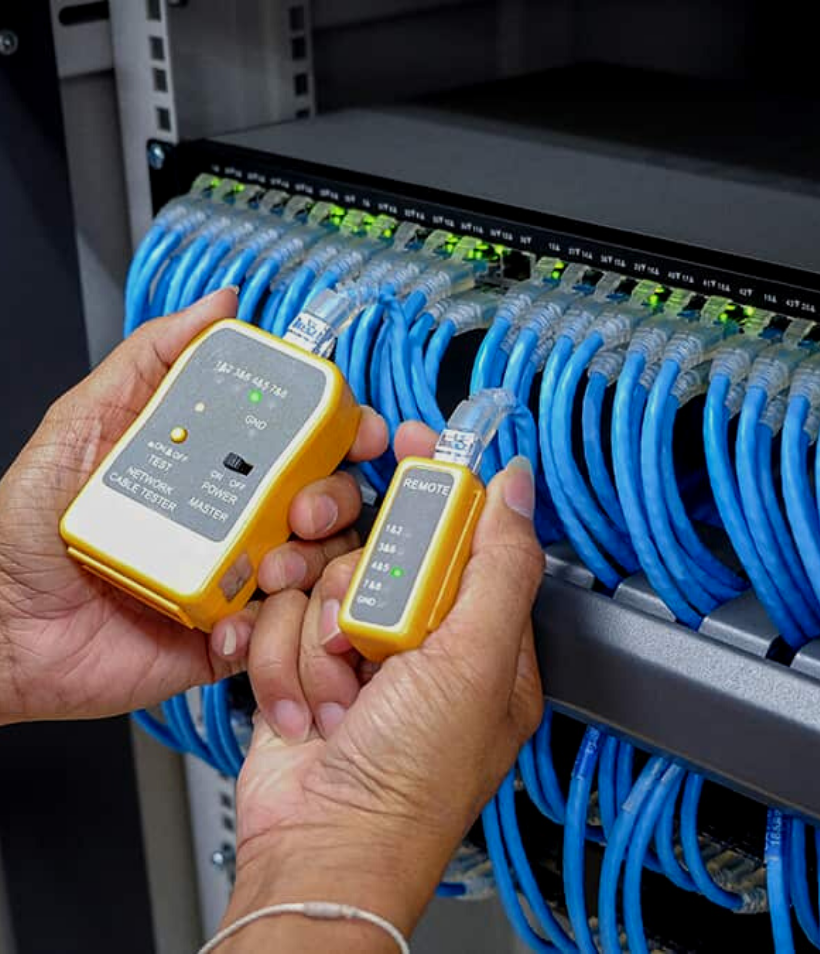
A cable that looks right can still fail. The most common cabling defects in Sacramento commercial buildings — split pairs, excessive untwist at keystone terminations, marginal insertion loss, and high near-end crosstalk — are completely invisible to the eye. You cannot see them. You cannot feel them. You cannot identify them with a basic cable tester. Only a precision instrument like the Fluke DSX-8000 CableAnalyzer, measuring to TIA-568.2-D standards, can find them.
The consequences of failing to test range from frustrating to catastrophic: network drops that only happen under load, VoIP call quality problems with no obvious cause, PoE devices that intermittently lose power, 10 Gigabit links that won’t negotiate, and WiFi access points that hit 300 Mbps instead of 1 Gbps because the PoE switch is throttling power to a phone that measures as underpowered on the link. Every one of these problems is difficult to diagnose once equipment is deployed — and straightforward to find and fix with proper testing before deployment.
We test every run we install as part of every project we deliver. We also test cabling installed by other contractors, audit existing infrastructure in Sacramento buildings, and provide the third-party certification reports that equipment warranty programs, building management companies, and compliance frameworks require. If your cabling hasn’t been certified, it hasn’t been proven.
| Test Method | What It Checks | What It Misses | Suitable For |
|---|---|---|---|
| Continuity Tester e.g. Klein VDV500 | Continuity, shorts, opens, miswires | Insertion loss, NEXT, return loss, delay skew — all crosstalk parameters | Verifying a connection exists. Not suitable for performance certification. |
| Cable Certifier — Level II e.g. older Fluke DTX | Wiremap, length, basic insertion loss | Level IV accuracy — may pass marginal cables at Cat6A that a Level IV tester fails | Cat5e and Cat6 at lower speeds. Not sufficient for Cat6A certification. |
| Fluke DSX-8000 What We Use | All TIA-568.2-D parameters to Level IV accuracy — insertion loss, NEXT, FEXT, return loss, PS-NEXT, delay skew | Nothing relevant — this is the gold standard for copper cabling certification | Cat6A, Cat6, Cat5e certification to TIA-568.2-D. Required for most warranty programs. |
When Does Sacramento Require Cabling Certification?
Certified test reports are typically required in four situations in Sacramento commercial installations: (1) equipment manufacturer warranty registration — most major networking vendors (Cisco, Commscope, Belden, Panduit) require certified test reports to activate extended warranty programs on network equipment; (2) building management and tenant improvement documentation — many Sacramento Class A and Class B commercial buildings require certified test records as part of the tenant improvement permit close-out; (3) compliance frameworks — ISO 27001, SOC 2, HIPAA, and PCI DSS all include physical infrastructure security requirements that cable certification records support; (4) pre-purchase or pre-lease building due diligence — when a business is taking on a new space or acquiring an existing one.
Parameters We Measure on Every Copper Run
Confirms all 8 conductors are correctly connected end-to-end with no opens, shorts, miswires, split pairs, or reversed pairs.
Signal attenuation across the full frequency range. Excess insertion loss causes link failures, especially at 10GBase-T frequencies above 200 MHz.
Electromagnetic interference between pairs at the transmitter end. The most common failure on poorly terminated Cat6/Cat6A — especially with excessive untwist.
Crosstalk measured at the far end of the link. Equal Level Far-End Crosstalk (ELFEXT) normalised for insertion loss — critical for 10G operation.
Signal reflected back toward the transmitter due to impedance discontinuities — caused by poor terminations, kinks, and out-of-spec connectors.
The combined crosstalk from all disturbing pairs simultaneously. More stringent than pair-to-pair NEXT — required for full-duplex 10G transmission.
Power sum attenuation-to-crosstalk ratio at the far end. The composite measure that determines whether a link can support the target bit rate.
Propagation delay and the difference in delay between pairs. Excess delay skew causes multi-pair transmission failures — often caused by using non-standard cable.
Copper Certification Deliverables
| Category | Frequency | Speed Support | Level Required | Notes |
|---|---|---|---|---|
| Cat5e | 100 MHz | 1 Gbps | Level IIIe | Level IV exceeds the requirement — what we use regardless |
| Cat6 | 250 MHz | 10 Gbps <55m | Level IV | Most manufacturer warranties require Level IV certification |
| Cat6A Most Common | 500 MHz | 10 Gbps to 100m | Level IV — mandatory | Cannot certify Cat6A with a Level II or III tester |
| Cat8 | 2000 MHz | 25G / 40 Gbps | Level IV | Short-reach data center applications. Fluke DSX-8000 is Cat8-capable. |
Why We Use the Fluke DSX-8000 — Not a Cheaper Certifier
The Fluke DSX-8000 is the industry benchmark for copper cable certification. At roughly $15,000 per unit, it’s an investment most Sacramento cabling contractors skip — opting for lower-accuracy testers that cannot reliably certify Cat6A. Level IV accuracy means the tester’s own measurement uncertainty is accounted for in the pass/fail result, so a pass result actually means the cable meets the standard. With a Level II tester, a marginal Cat6A run might pass the certifier’s test while actually failing the TIA-568.2-D standard — only to cause problems once 10G network equipment is deployed. We use the right tool because our test reports need to be defensible.
OTDR Bidirectional Testing
Every fiber strand tested from both ends — A-to-B and B-to-A. Bidirectional testing is required by TIA-568.3-D and eliminates the optical masking effect that can hide connector faults when testing from only one direction. You receive a trace from both ends for every strand.
Insertion Loss Measurement
End-to-end insertion loss measurement for every fiber strand using an optical loss test set (OLTS) with calibrated light source and power meter. The measurement your transceiver vendor needs to confirm the link is within the optical power budget for the intended speed and transceiver type.
End-Face Inspection
Every connector end-face inspected with a 400x fiber inspection microscope before mating. IEC 61300-3-35 pass/fail grading. A contaminated end-face causes connector insertion loss 5–10x higher than a clean one — and the contamination is invisible to the naked eye.
Splice Performance Testing
For fiber runs with fusion splices — whether in splice enclosures on a building riser or in a data centre tray — we test each splice with the OTDR and measure individual splice loss. Typical fusion splice loss is below 0.05 dB; we flag anything above 0.1 dB for re-splicing.
Fault Location
When a fiber run fails — excessive insertion loss, a high-loss connector, a break in the cable — the OTDR identifies the fault location to within a metre. We provide the fault location in metres from each end so you know exactly where in the pathway to look.
MPO/MTP Array Testing
High-density MPO/MTP 12-fiber and 24-fiber array testing for data centre applications and structured fiber systems. Individual strand testing within the MPO array. Polarity verification per TIA-568.3-D Methods A, B, and C.
Fiber Testing Deliverables
| Fiber Type | Test Standard | Max Connector Loss | Max Splice Loss | OTDR Wavelengths |
|---|---|---|---|---|
| OM3 Multimode | TIA-568.3-D | 0.75 dB | 0.3 dB | 850 nm, 1300 nm |
| OM4 Multimode Standard | TIA-568.3-D | 0.75 dB | 0.3 dB | 850 nm, 1300 nm |
| OS1 Single-Mode | TIA-568.3-D | 0.75 dB | 0.3 dB | 1310 nm, 1550 nm |
| OS2 Single-Mode | TIA-568.3-D | 0.75 dB | 0.3 dB | 1310 nm, 1550 nm |
Fiber Testing After Third-Party Installation in Sacramento
We regularly test fiber cabling installed by other contractors — building landlord-provided fiber risers, carrier-installed dark fiber, and fiber installed by general low-voltage contractors who don’t own OTDR equipment. If you’ve had fiber installed and you’re about to deploy transceivers for a 10G or 40G network, having the fiber tested before equipment deployment is significantly less expensive than troubleshooting link errors after deployment. A single bad connector on a fiber riser can bring down an entire floor’s connectivity, and the OTDR finds it in minutes.
Need third-party certification for existing cabling in your Sacramento building?
We test infrastructure installed by others and issue signed TIA-568 certification reports. Free quote, usually on-site within 3–5 days.
Physical Plant Inventory
A complete inventory of the existing cabling infrastructure — cable types, approximate run counts, telecom room equipment, patch panel and port inventory, and overhead pathway condition. The baseline record of what exists before any changes are made.
TIA-568 Compliance Testing
Sampling or full Fluke DSX-8000 certification testing of existing copper runs to determine what percentage of the installation meets current TIA-568.2-D standards. Identifies runs that are out-of-spec and may be causing intermittent performance problems.
Documentation Audit
Assessment of existing documentation — port maps, as-built drawings, test records, cable schedules. Identifies what documentation exists, what’s missing, and what’s inaccurate. Most Sacramento commercial buildings have significant documentation gaps from past cabling work.
Cable Category Assessment
Physical identification of installed cable categories — Cat5e vs Cat6 vs Cat6A — and whether the installed cable is adequate for the network speeds and PoE applications currently planned. Common finding in older Sacramento buildings: Cat5e installed where Cat6A is now required.
Telecom Room Assessment
Evaluation of IDF and MDF conditions — rack space availability, patch panel organisation, cable management quality, labelling accuracy, grounding infrastructure, and physical security. Identifies the telecom room issues most likely to cause ongoing operational problems.
Remediation Recommendations
A prioritised remediation report: which issues require immediate action, which should be addressed in the next upgrade cycle, and which are documentation-only issues. Provides the basis for an accurate scope and budget for any cabling remediation work.
Cabling Audit Deliverables
When Sacramento Businesses Commission Cabling Audits
The most common reasons Sacramento businesses call us for a cabling audit: taking on a new office space and needing to know if the existing cabling is usable; experiencing unexplained network performance problems that IT suspects are physical layer; preparing for a 10G network upgrade and needing to know if existing Cat6 infrastructure is adequate; building or company acquisition due diligence; and compliance program requirements (ISO 27001, SOC 2, PCI DSS) that require documented physical infrastructure security. We’ve audited cabling in DTLA law firm server rooms, Century City financial services offices, Burbank production facilities, and multi-tenant office buildings across the South Bay.
Post-Installation Independent Testing
Testing cabling after it’s been installed by another contractor — before equipment is deployed. The most valuable timing for testing: problems can be found and remediated before network equipment goes live, and your installing contractor is still responsible for fixing what they installed.
Building Management Documentation
Many Sacramento Class A and Class B commercial buildings — particularly in Downtown Sacramento and major business districts — require certified test records as part of the tenant improvement close-out package submitted to building management. We provide complete test documentation in the format required, ensuring smooth project sign-off and compliance with property management standards.
Manufacturer Warranty Testing
Most major structured cabling warranty programs — Commscope, Panduit, Belden, Leviton, Legrand — require independent Level IV certification to activate the extended warranty (typically 20–25 years). We provide the testing and issue reports in the format required for warranty registration.
Compliance Program Documentation
ISO 27001, SOC 2 Type II, PCI DSS, and HIPAA security frameworks all include physical infrastructure requirements. Certified test records for structured cabling support the physical access control and infrastructure security controls in these frameworks. We issue reports suitable for compliance auditor review.
Re-Testing After Remediation
If a previous test identified failing runs and a contractor has remediated them, we re-test to confirm the remediation was successful and issue updated certification reports. Common scenario: contractor re-terminated failing keystones but used a basic tester to confirm — we certify to Level IV standard.
Testing for Other Contractors
Low-voltage cabling contractors who don’t own a Fluke DSX-8000 can engage us to provide the certification testing for their projects. We provide the test reports under their project documentation, or directly to the end client as specified. Flexible scheduling to fit your project timeline.
Can an Installing Contractor Certify Their Own Work?
Technically yes — and most do. But there is a meaningful difference between a contractor testing their own installation (where they have an incentive to pass every run) and an independent contractor testing it. Major warranty programs from Commscope, Panduit, and Belden specifically require independent certification because they understand this dynamic. For any installation where the certification records may be reviewed by a third party — building management, a compliance auditor, an equipment warranty department, or a future tenant — independent third-party certification is the appropriate standard. We are frequently called to re-test installations in Sacramento where the original contractor’s test reports are questioned, incomplete, or don’t meet Level IV accuracy requirements.
The most common failure in Sacramento installations. TIA-568.2-D allows a maximum of 13mm (Cat5e) or 6mm (Cat6) of untwist at the keystone termination. Many installers untwist far more for easier termination — this destroys the pair’s crosstalk rejection and causes NEXT failures that are often marginal: the run works at 1G but fails at 10G.
Wiring conductors from two different pairs to the same pin position — for example, using the blue conductor from pair 2 and the orange conductor from pair 3 on the same differential pair. Passes a basic continuity test. Fails NEXT catastrophically. Often found in Sacramento buildings where phone wiring was used as data cabling or where untrained installers terminated without checking pair assignments
Cat5e or Cat6 cable mislabelled as Cat6A. Cat6 runs that exceed the 90-metre horizontal cable distance limit. Both produce insertion loss failures that only show up under full load at 10G speeds. We find mislabelled cable regularly in Sacramento commercial buildings — especially where building management or a previous tenant installed “structured cabling” without proper material verification.
Return loss failures caused by kinks in the cable, over-tightened cable ties, cable damaged during installation, or out-of-specification connectors. Often occurs when cable is pulled through tight conduit runs in older Sacramento concrete commercial buildings without proper lubricant, or when bundle ties are cinched too tight on overhead cable trays.
The single most common fiber failure. A contaminated connector end-face can add 1–3 dB of insertion loss — enough to put a fiber link outside its optical budget. Invisible to the naked eye. Found in virtually every fiber installation that wasn’t end-face inspected after installation. 90% of fiber failures we find in Sacramento buildings are connector contamination, not cable damage.
Cat6 cable with high DC resistance — from excessive run length, poor termination contacts, or undersized conductor gauge — can cause PoE devices to receive less power than the switch is allocating. The device runs in reduced-power mode without any obvious error: WiFi 6 APs that can’t reach full transmit power, IP cameras that can’t use IR illumination, VoIP phones that can’t charge a USB handset. Only a PoE power tester finds this.
Alarm cable, audio cable, or non-standard data cable mixed into a run — sometimes as a patch because the installer ran out of Cat6A, sometimes because the building had existing cable that was “tested and working.” Delay skew failures from non-standard cable are common in older Sacramento buildings where cabling has accumulated over many years and nobody has a complete record of what’s in the walls.
We encounter Sacramento installations where a contractor delivered a handwritten port list and claimed testing was done — but no Fluke reports were produced. Or where Fluke reports exist but are from a Level II instrument incapable of certifying Cat6A. When a client asks us to re-test, we typically find a 15–25% failure rate on runs that were “certified” by the previous contractor.
The Right Equipment — Fluke DSX-8000
We own and operate a Fluke DSX-8000 CableAnalyzer — the Level IV instrument required to properly certify Cat6A cabling. At roughly $15,000 per unit, many Sacramento cabling contractors don’t own one and certify Cat6A with lower-accuracy equipment. Our test reports are defensible because they’re produced with the right tool.
We Test What We Install — No Self-Certification Bias
Our technicians certify their own installations — not for conflict of interest, but because we build testing into every project scope as a technical requirement. Every installation is certified before we hand it over. You don’t need to separately commission testing work because it’s already included.
Independent Third-Party Testing Available
When you need testing that didn’t come from the installing contractor — for warranty registration, building management documentation, or compliance records — we provide fully independent certification. No relationship with the installing contractor. Reports issued on our letterhead with our BICSI credentials.
BICSI-Certified Technicians
Our technicians are BICSI certified — trained and tested on the standards that govern cable testing, including the TIA-568 series, TIA-569, and the fiber testing standards in TIA-568.3-D. BICSI certification isn’t required to own a Fluke — but it means our technicians understand what the test parameters mean and can diagnose failures correctly.
Fail Analysis Included
When a run fails, we don’t just mark it fail and move on. We identify the fault location, the parameter that failed, and the probable cause — so whoever remediates it knows exactly what to fix. This is the difference between a test report and a useful test report.
Reports in Every Required Format
PDF test reports for every run. CSV export for integration with cable management databases. Consolidated summary reports. Manufacturer warranty registration formats. Building management documentation packages. Compliance program evidence packages. We’ve produced test report packages for every major Sacramento commercial building management company and major compliance framework.
New Office Build-Outs — Countywide
Certifying all structured cabling in a new Los Angeles tenant improvement before equipment is deployed. Identifies any installation defects while the installing contractor is still responsible for remediation. The right time to test is before your IT team starts deploying switches and APs.
Network Upgrade — 1G to 10G
Before upgrading to 10 Gigabit switches, certifying existing Cat6 infrastructure to confirm it meets 10GBASE-T performance requirements. Cat6 supports 10G to 55m — Cat6A to 100m. Many Sacramento offices have Cat6 runs over 55m that will fail at 10G. Find out before you buy the switches.
VoIP Call Quality Troubleshooting
Auditing physical cabling infrastructure when VoIP call quality is poor or intermittent and the phone system vendor has exhausted logical layer diagnoses. The Fluke DSX-8000 finds physical layer issues — marginal insertion loss, NEXT, PoE delivery — that software-based diagnostics cannot see.
WiFi Performance Issues
Testing Cat6A home runs to access points when WiFi speeds are lower than expected. PoE delivery testing when APs are underperforming. A single marginal Cat6A run can limit an AP to reduced PoE power mode — throttling its transmit power and effectively halving its coverage radius.
Pre-Purchase Due Diligence — Sacramento Commercial Buildings
Certifying the cabling infrastructure in a commercial building before acquisition or a long-term lease commitment. Provides an accurate picture of what remediation will be required and at what cost — important information for lease negotiation or acquisition due diligence.
Manufacturer Warranty Registration
Providing the independent Level IV certification reports required to register 20–25-year extended warranty programs with Commscope, Panduit, Belden, Leviton, Siemon, and other manufacturers. We’ve processed warranty registrations for Sacramento commercial installations with all major structured cabling manufacturers.
Compliance Audits — ISO 27001 / SOC 2 / PCI DSS
Providing physical infrastructure documentation for compliance framework evidence packages. ISO 27001 Annex A.11, SOC 2 Common Criteria CC6, and PCI DSS Requirement 9 all include physical access control and infrastructure requirements that cable certification records support. We issue reports suitable for compliance auditor review.
Server Room & Data Center Cabling
Certifying structured cabling in Sacramento server rooms and data centers — Cat6A horizontal runs, fiber backbone, MPO arrays. TIA-942-B-compliant test records for data center environments. OTDR traces for every fiber strand in the building’s backbone.
Sacramento Core
Downtown Sacramento
Midtown
East Sacramento
Downtown Sacramento
Natomas
Greater Sacramento Area
Elk Grove
Rancho Cordova
Folsom
Citrus Heights
Carmichael
Fair Oaks
North Highlands
Antelope
Roseville
Rocklin
Lincoln
Yolo County & West Sacramento
West Sacramento
Davis
Woodland
Placer & Surrounding Business Corridors
Granite Bay
Loomis
Auburn
Paul W. – Head of IT Infrastructure · Financial Services, Downtown Sacramento
“We inherited an office in Downtown Sacramento with no cabling documentation and persistent 10G link failures on two floors. Sacramento Data Cabling audited the entire building in two days — identified three runs with split pairs that a previous contractor had ‘certified,’ twelve runs with excessive untwist causing marginal NEXT, and four runs that were Cat5e mislabeled as Cat6. The remediation scope matched exactly what they predicted. Zero link failures since.”
Rachel M. – IT Director · Professional Services Firm, Downtown Sacramento
“We needed independent third-party certification for a Commscope warranty registration on our new DTLA server room. The installing contractor didn’t own a Fluke DSX-8000 — they tested with a DTX-1800 which Commscope doesn’t accept. Sacramento Data Cabling came in, re-tested all 340 runs in one day, delivered proper Level IV reports, and we got our 25-year warranty registered without issue.”
Dan K. – Technical Operations Manager · Production Facility, Sacramento
“Our Sacramento production facility had chronic WiFi dead spots despite having brand-new Meraki APs. Two different contractors checked the APs and configuration and found nothing. Sacramento Data Cabling tested the Cat6A home runs to the APs and discovered that three runs had marginal PoE delivery — the APs were operating in reduced power mode. They re-terminated those three runs, the APs switched to full power, and the dead spots disappeared. It should have been tested properly from the start.”
Tom C. – Principal · Managed Service Provider, Sacramento
“We’re an MSP that serves about 40 LA businesses. We’ve been using LA Data Cabling for third-party testing on client installations for two years — whenever we take over a network and the cabling history is unknown, we bring them in to audit and certify. Their reports are detailed, their fail analysis is accurate, and they’ve found physical layer problems that would have taken us months to diagnose otherwise. Highly recommend to any Sacramento-area MSP.”